Guide
Hiring a flat roofer
This is buyer advice that applies to any contractor you consider, including us. Ask for the papers, get the scope in writing and compare like with like.
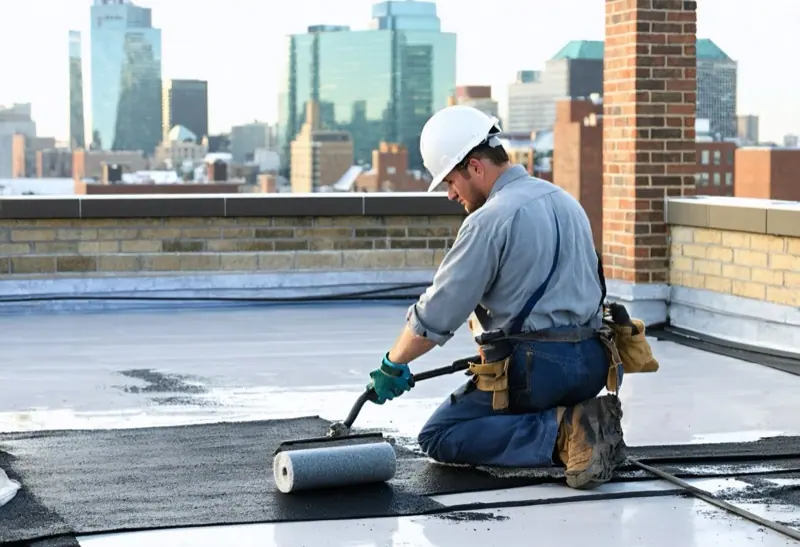
Why it is worth asking
Roofing is one of the more dangerous trades, and flat roof work adds hot materials, large loads and workers near the roof edge. If a contractor has no workers’ compensation coverage or no liability insurance, the risk of an accident or damage can land on the property owner. Asking for the documents costs nothing and takes a few minutes.
The same goes for the work itself. A written scope protects both sides. It says what will be done, with what, and what happens when the roof turns out to be worse than it looked.
Ask to see these before work starts
WSIB clearance certificate
In Ontario, a clearance certificate shows that a contractor is in good standing with the workplace insurance board. Ask for a current one, and check its date. Rules on who needs coverage depend on the business, so if in doubt ask WSIB or your adviser.
Proof of liability insurance
Ask for a certificate of insurance naming the limit and the dates. Property managers and condo boards often require a minimum limit and to be named on the policy.
Working-at-heights training
Under Ontario’s working-at-heights rules, workers who use fall protection on construction projects must have completed an approved training program, and the training is valid for a set period. Ask to see proof for the crew on your job, and ask how the roof edge will be protected.
A written scope of work
Tear-off, deck repair, insulation, membrane, flashings, edge metal, drains, cleanup. Each named, with the product and thickness.
Manufacturer warranty terms
Ask whether the membrane comes with a manufacturer warranty, and get its terms in writing: what it covers, who must install, how long and how to claim.
Contractor’s own workmanship terms
Separate from the manufacturer. Ask what the contractor commits to in writing and for how long.
Questions about the work
How will you find and price hidden damage?
Look for a stated unit price per sheet of decking or per square foot of wet insulation, so extras are not a surprise.
How will the roof be kept watertight each night?
A good answer describes tie-offs, temporary seals and weather checks.
How will the torch, hot work or fumes be handled?
Many contractors use cold-applied or self-adhered systems where a torch is unsafe. Ask what is proposed and why.
Who will be on site?
Ask who supervises and whether subcontractors are used.
Are permits needed?
Rules differ by municipality. See re-roofing permits.
What is the payment schedule?
A small deposit, a progress payment if the job is large, and a final payment after a walk-through is common. Be cautious about demands for the whole price up front.
Comparing quotes
Line up quotes side by side and compare each item. If one quote leaves out insulation, drains, flashings or tear-off, it is not the same job. Ask each roofer to price the same scope, or ask why theirs differs. See flat roof cost in Ontario for the usual factors.
Be careful of quotes that are far below the rest, quotes with no written scope, and promises that cannot be checked. A reasonable roofer will explain their price.
What you can do to help the job go well
Prepare the information in preparing for a roof quote, clear access to the roof, keep pets and people away from the work area and give the contractor a single contact. For buildings, add a notice to residents or tenants. For a board, bring the written scope to the meeting; see condo roof planning.
A short contract checklist
Whatever the size of the job, the paperwork should cover the same things: both parties’ names and addresses, the property address, the scope with products named, the price and what is and is not included, the unit prices for hidden damage, the payment schedule, the start and finish estimate, who handles permits, how changes are agreed in writing and what the contractor commits to for workmanship.
Read it before you sign, not after the truck arrives. If a term is unclear, ask for it to be rewritten. Keep a copy with the roof file.
Red flags and good signs
Good signs: the contractor visits the roof before quoting, asks about the building below, explains what could change the price, puts everything in writing and sends the documents without being chased. Red flags: a quote from a phone call alone for a large roof, pressure to sign today, a request for most of the money up front and no written scope.
A price far below others on the same scope usually means something has been left out. A price far above may include extras you have not asked for. In both cases the way to find out is to ask the contractor to walk through the quote line by line.
Questions about hiring
Should I get three quotes?
Two or three is reasonable for a large job. Make sure each is for the same written scope.
Is the lowest quote a red flag?
Not by itself. It is a reason to check what is missing from it.
What if the roofer wants cash only?
Ask for a written contract and an invoice in every case. A request that avoids paperwork is a reason to be careful.
Leak, damage or an old flat roof?
Send a few details and photos. We reply by email with next steps and a written quote.