Where most leaks begin
Flashing and seam repair
The large flat sheet of a roof membrane rarely fails first. The joins do: the seams, the edges and the places where the roof meets a wall.
- Walls, parapets, curbs
- Heat-welded and glued seams
- Starting price listed
What flashing is and why it fails
Flashing is the waterproof detail where the membrane meets something else: a parapet, a chimney, a wall, a curb or the roof edge. Walls and roofs move at different rates with temperature and frost, and that movement pulls on every flashing. The termination bar loosens, sealant dries, and water gets in behind.
Seams fail for related reasons. Heat and cold stretch and shrink the sheet, adhesive ages, and a lap that was never fully bonded lifts at the corner. The pages on flashing leaks and open seams show what to look for.
What we repair
Wall and parapet flashing
Membrane turned up the wall, with a termination bar and sealant, covered by metal counterflashing or cap.
Roof edges and drip edge
Metal edging refastened, replaced or re-lapped under the membrane.
Corners and transitions
Inside and outside corners, where fabricated pieces matter more than sealant.
Seam repair
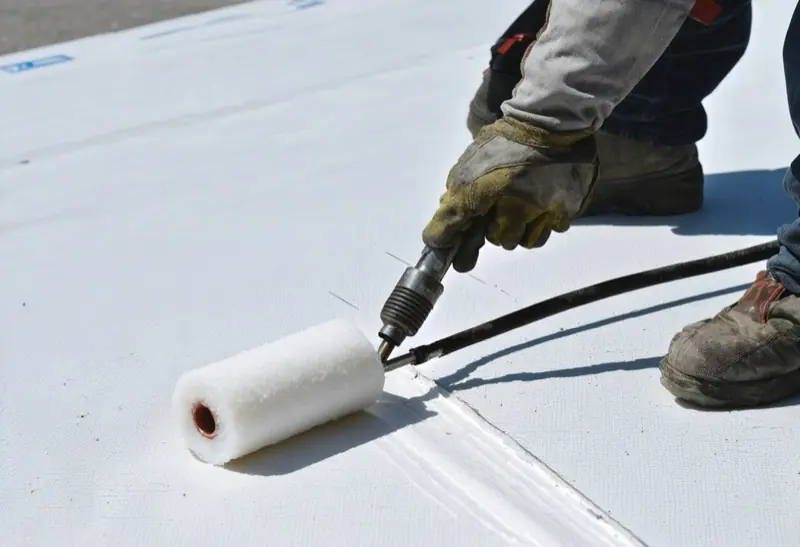
Cleaned and rejoined by heat-welding on TPO and PVC, by adhesive or splice tape on EPDM, and by patching on bitumen systems.
Pitch pockets and penetrations
Old pitch pockets are replaced with proper boots or collars. See skylight and penetration repair.
Repair sequence
Identify the failure
Pull back loose areas, check the substrate and note whether the membrane or the sealant has failed.
Clean and prepare
Seams and flashings only bond to clean, dry, correctly primed surfaces.
Rebuild the detail
New membrane flashing, fresh terminations and, where needed, metal replaced or added.
Seal and test
Check that every edge is bonded, and probe seams for gaps.
Flashing and seam pricing
| Item | Starting price |
|---|---|
| Flashing repair or replacement | from $500 per repair |
| Skylight, curb or vent reflashing | from $350 per opening |
| Small leak repair (patch, seam or puncture) | from $350 per repair |
Starting prices in CAD before 13% HST, based on typical Ontario contractor rates (mostly Toronto and the GTA). The final price depends on roof size, access, the layers to remove, the membrane, drains and flashings, and is confirmed in your written quote.
Long runs of wall flashing, masonry that needs repointing, and work at height raise the price.
Questions about flashings and seams
Is caulking a flashing a real repair?
It is a short-term measure. Sealant dries and cracks with movement. A real repair rebuilds the detail so the sealant is a backup, not the barrier.
Why does the leak only show in heavy rain?
Wind-driven rain pushes water behind a loose flashing. In light rain the same gap stays dry.
Do I need to fix the masonry too?
If brick or stucco above the flashing is cracked, water can enter behind it. We note it in the report. The masonry repair itself is for a mason.
Leak, damage or an old flat roof?
Send a few details and photos. We reply by email with next steps and a written quote.