White heat-welded membrane
TPO roofing
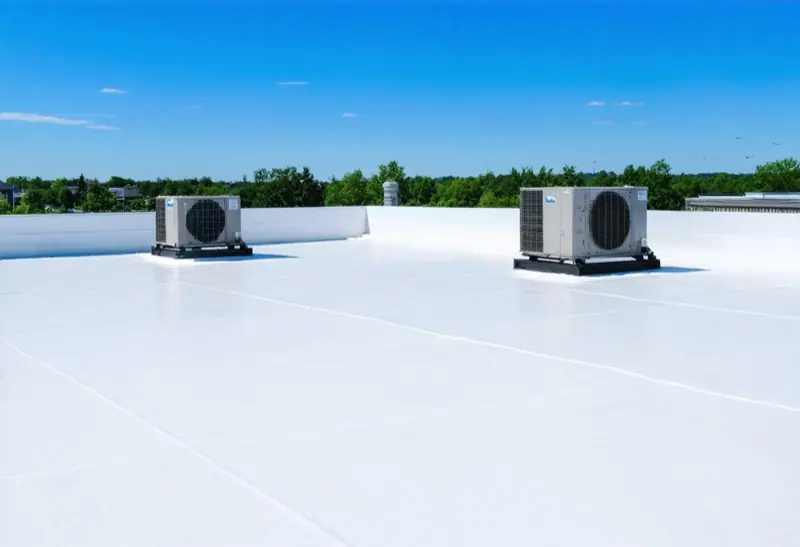
TPO is the white or light grey single-ply you see on warehouses, plazas and schools. Seams are welded with hot air rather than glued, and the surface reflects sunlight.
- Heat-welded seams
- Reflective surface
- Common on commercial roofs
What TPO is
TPO is thermoplastic polyolefin. A thermoplastic softens when heated, which is what makes welded seams possible: two sheets are overlapped, a welder passes hot air between them, and a roller presses them into one piece. When it is done right the seam is as strong as the sheet.
TPO roofs commonly last 15 to 25 years. Pricing for a full replacement is from $9 per sq ft. Large commercial roofs are quoted on their own terms; see pricing.
Attachment methods
Mechanically fastened
Screws and plates are placed along the seam edge, then covered by the next sheet. Common on large commercial roofs because it is quick and keeps cost down.
Fully adhered
The membrane is bonded to the insulation or cover board with bonding adhesive. Preferred on roofs with high wind exposure, or where a smooth surface is wanted, such as above a rooftop terrace.
Induction welded
Plates under the insulation are heated through the membrane to bond it without penetrations. Used mostly on larger commercial projects.
How TPO behaves in Ontario winters
TPO performs well through freeze–thaw cycles when it is a reputable product installed on dry, clean insulation. The concerns are mostly at the edges of its range. Some older or lower-quality TPO sheets have been known to craze or crack at seams, and the thinner the sheet the less margin there is for foot traffic and hail.
Because manufacturers change TPO formulations, ask for the specific product name and thickness in the written quote, not just "TPO". That detail tells you far more than the colour.
Strengths and weaknesses
Reflective surface
A white roof stays cooler in July, which can cut cooling load for buildings with rooftop units.
Hot-air welded seams
Welds are stronger than glued seams if done on a clean, dry sheet at the right temperature.
Lower material cost
TPO is usually among the cheaper single-ply options, which is why it dominates large commercial work.
Quality varies by product
Formulations differ between manufacturers. The cheapest sheet is not always the same as the cheapest roof over twenty years.
Dirt and ponding
White membranes show dirt and algae, and a ponding area can discolour and age faster than the rest of the sheet.
Welder skill matters
A poor weld looks fine from the roof edge. Probe testing of seams is the way to find weak ones.
How TPO seams are repaired
Probe the seams
A thin probe is run along the edge of a seam to check that it is fused. Open spots are marked.
Clean the sheet
Old TPO often has a layer of dust and chalking. It is scrubbed back and wiped with the cleaner the manufacturer calls for.
Weld on a cover strip
A strip of new TPO is hot-air welded over the open seam, with rounded corners so water does not catch the edge.
Seal the cut edge
Any cut edge of reinforcing fabric is sealed to stop water wicking into the sheet.
TPO pricing
| Item | Starting price |
|---|---|
| TPO roof replacement | from $9 per sq ft |
| Commercial roof replacement | from $8 per sq ft |
| Flashing repair or replacement | from $500 per repair |
Starting prices in CAD before 13% HST, based on typical Ontario contractor rates (mostly Toronto and the GTA). The final price depends on roof size, access, the layers to remove, the membrane, drains and flashings, and is confirmed in your written quote.
TPO questions
Is TPO or PVC better for a restaurant roof?
PVC resists grease and animal fats, so it is the safer pick near kitchen exhaust. TPO is normally fine where the roof is dry and quiet. See PVC roofing.
Can TPO be installed over an old tar and gravel roof?
Sometimes, over a suitable cover board and after a moisture check. The gravel is usually removed first. An inspection will show whether the old layers are dry.
How can I tell if my TPO seams are failing?
Look for lifted edges, hairline cracks along the weld, or water stains on the ceiling beneath the seam line. A probe test is more reliable than eyeballing it from the ladder.
Leak, damage or an old flat roof?
Send a few details and photos. We reply by email with next steps and a written quote.