Property types
Flat roofs on warehouses and industrial buildings
Warehouse roofs are big, simple and expensive to get wrong. The goal is to keep goods dry and operations running, and to spend on the roof only where the roof needs it.
- Large low-slope roofs
- Steel and concrete decks
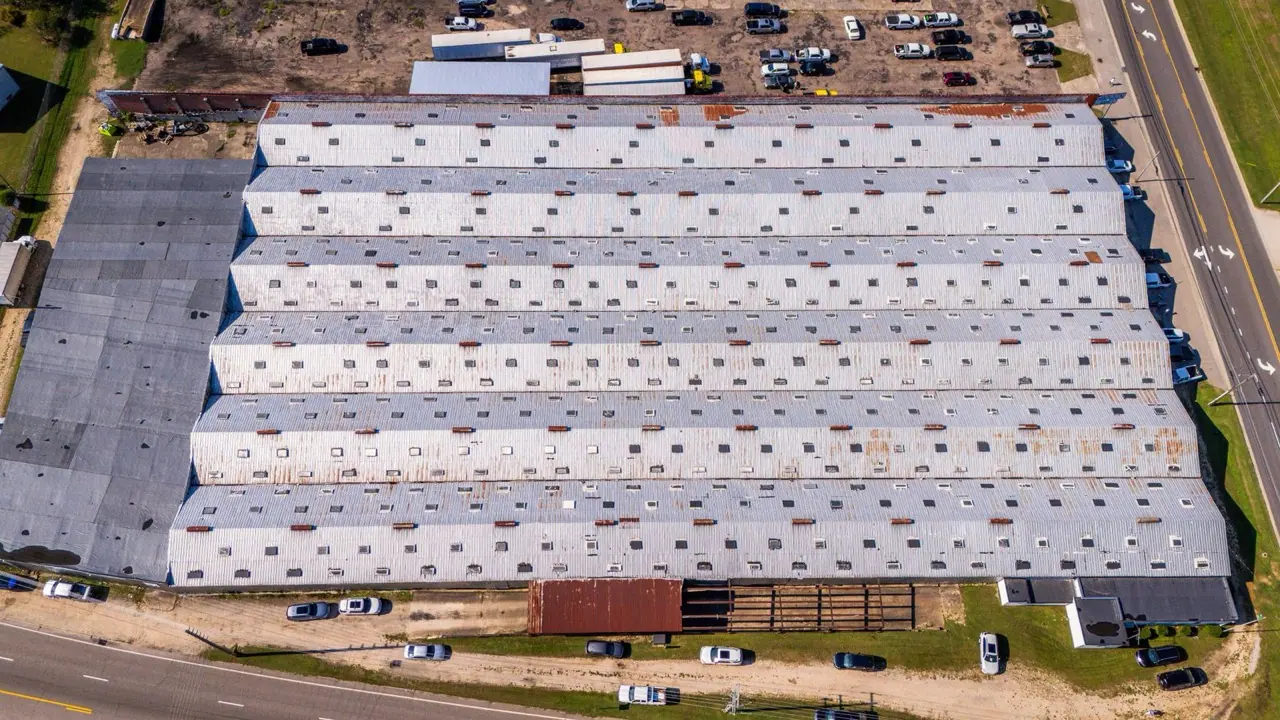
What is different about a warehouse roof
Warehouse and industrial roofs cover tens of thousands of square feet, often on a steel deck with rigid insulation and a single-ply or built-up membrane. The area is large, so small differences in unit price become big differences in total price, and a few good decisions (coating instead of replacing, phasing instead of one block) can change the budget by tens of percent.
Operations underneath cannot stop for long. Racking, shipping docks and sensitive stock all sit below the roof, so a leak is not just a repair cost but lost product and downtime.
Problems we see most
Failed seams on large sheets
Seams are the longest line of risk on a big roof. See open seams.
Ponding at mid-span
Steel deck deflection lets water pool far from drains. See ponding water.
Wind damage at edges and corners
Wind lifts membrane at perimeters first. See wind damage.
Penetrations and old patches
Vents, skylights and curbs added over decades. See skylight and penetration repair.
Wet insulation in sections
A leak may soak a large area of insulation that looks fine on top.
Repair, coat or replace
On a large roof the choice has money attached. A roof that is dry underneath and sound on top may suit a coating, which is priced per square foot well below replacement. A roof with scattered wet insulation can be repaired in sections. A roof with failed seams and widespread moisture is a replacement. A moisture survey is the most reliable way to tell them apart before you commit to a budget.
See repair or replace a flat roof for the decision process.
Materials that tend to suit
TPO
Welded white sheets across large decks. Commonly 15 to 25 years. See TPO.
PVC
Where chemicals or food-processing exhaust reach the roof. See PVC.
EPDM
Large sheets with few seams; commonly 20 to 30 years. See EPDM.
Coating
A restoration option on a sound roof; commonly 7 to 20 years, depending on the coating.
How the work is planned
Survey
A roof walk with moisture mapping and a drawing of the zones.
Phasing
Roof zones are done one at a time with each zone sealed at the end of the day.
Material staging
A crane or hoist lifts rolls, insulation and tools; a clear laydown area is needed on the ground.
Operations
Dock doors, forklift routes and hot-work permits are agreed with the plant manager before the first day.
What to prepare
Roof area and drawings
Rough dimensions and any drawings, plus the deck type if known.
Operations rules
Site safety induction, hot-work rules and areas where goods must be protected.
Crane space
A hardstand for a crane and a place to stage materials.
Past leak map
Where leaks have appeared and when. See finding a flat roof leak.
Starting prices
| Item | Starting price |
|---|---|
| Commercial roof inspection and report | from $450 per roof |
| Commercial roof replacement | from $8 per sq ft |
| Roof coating (restoration) | from $3 per sq ft |
Starting prices in CAD before 13% HST, based on typical Ontario contractor rates (mostly Toronto and the GTA). The final price depends on roof size, access, the layers to remove, the membrane, drains and flashings, and is confirmed in your written quote.
Questions from plant and facility managers
Does the building need to shut down?
Normally no. Work is phased and sealed daily. Some tasks, such as loading near a lift, may need short pauses at specific docks.
How early should we plan a large replacement?
Start six to twelve months ahead so that surveys, quotes, approvals and a dry-season slot fit together.
Are hot works allowed on our site?
That depends on your facility rules and insurer. Ask about torch-free options if hot works are restricted.
Leak, damage or an old flat roof?
Send a few details and photos. We reply by email with next steps and a written quote.