Property types
Flat roofs on office buildings
An office tenant will put up with a few days of noise, but not with water on a server room or a ceiling tile on a desk. The roof plan has to protect the people and the equipment below.
- Low-rise and mid-rise offices
- Property managers and owners
What is different about an office roof
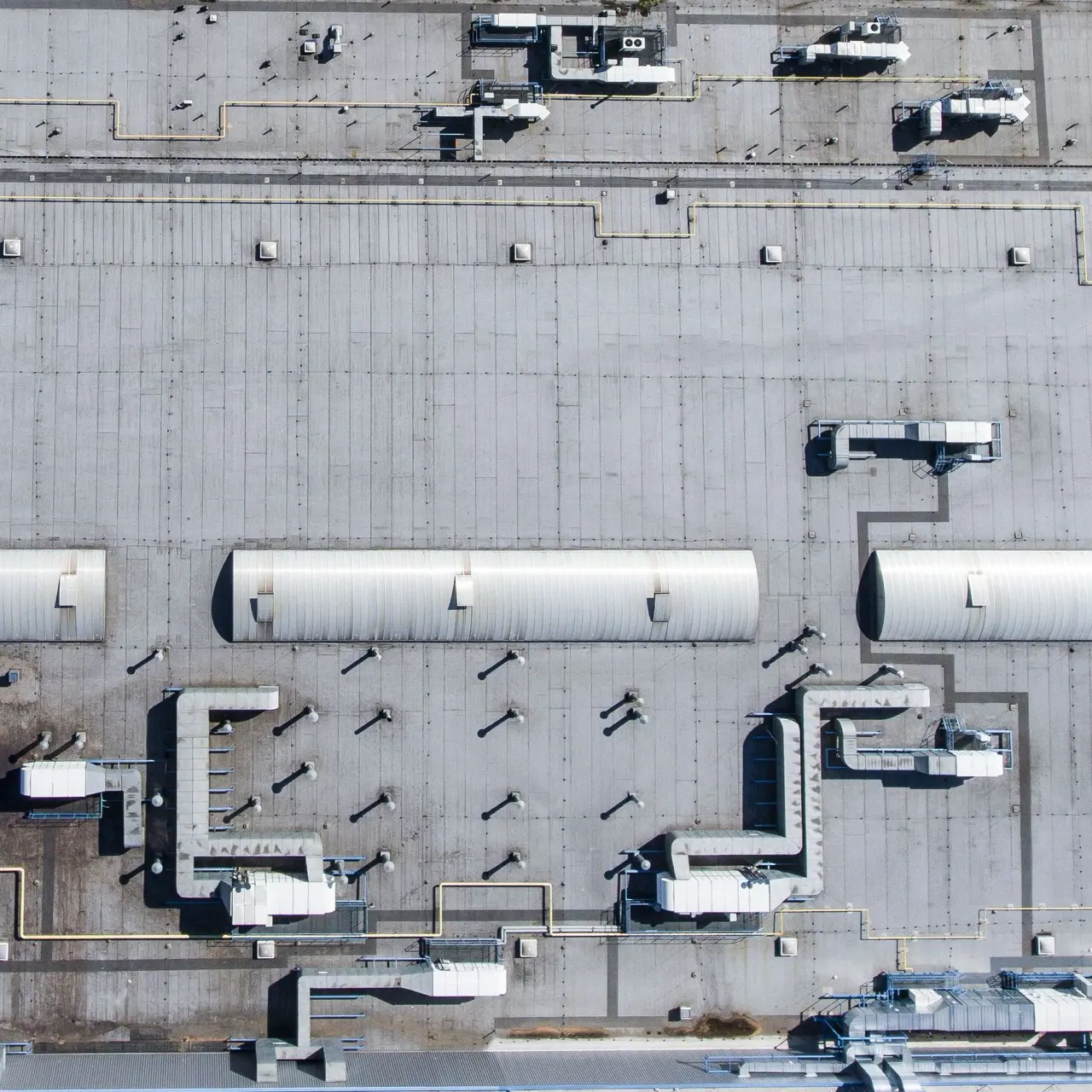
Office roofs are usually dense with mechanical equipment: rooftop units, exhaust fans, chillers, cooling towers and many pipes. The membrane around these items does most of the leaking, not the open field. Access often goes through a locked penthouse, a roof ladder or a hatch, which affects how materials get up.
Tenants care about three things: noise during working hours, dust or smell reaching the air intake, and leaks above sensitive rooms. A roof plan that addresses those three gets approved faster by the property manager.
Problems we see most
Leaks around equipment curbs
Old curb flashings split from vibration and heat. See flashing leaks.
Drain overflow in storms
Heavy summer storms overload undersized or clogged drains. See clogged drains.
Worn walkways
Service technicians walking one path wear the membrane there first. See open seams.
Condensation under the membrane
Poorly vented or under-insulated roofs can drip even without a leak. See ceiling water stains.
Materials that tend to suit
TPO or PVC
Heat-welded membranes common on commercial roofs; TPO commonly 15 to 25 years, PVC 20 to 30 years. See TPO and PVC.
Modified bitumen
A layered system where the roof sees a lot of foot traffic. See modified bitumen.
Tapered insulation
When adding insulation, a taper can move water to the drains and cut ponding. See tapered insulation.
How the work is planned around tenants
Intake and exhaust map
Mark the fresh-air intakes so adhesive fumes or torch smoke are kept away from them, or the units are shut down briefly with the building engineer.
Noisy work timing
Tear-off and nailing are scheduled for early mornings or weekends where the lease or the manager requires it.
Protection inside
Cover critical equipment below the work area and agree who checks the ceilings during the job.
Daily seal
Every section is made watertight each evening so a night storm does not find an open roof.
What the manager should prepare
Roof plan and equipment list
Even a sketch showing units, drains and penetrations speeds up the quote.
Building rules
Working hours, insurance paperwork you need from contractors, elevator booking and loading dock rules.
Tenant notices
A draft notice to tenants once dates are set.
Sensitive rooms
Server rooms, archives and labs under the roof. See finding a flat roof leak.
Starting prices
| Item | Starting price |
|---|---|
| Commercial roof inspection and report | from $450 per roof |
| Maintenance visit (drains, seams, flashings, photos) | from $295 per visit |
| Commercial roof replacement | from $8 per sq ft |
Starting prices in CAD before 13% HST, based on typical Ontario contractor rates (mostly Toronto and the GTA). The final price depends on roof size, access, the layers to remove, the membrane, drains and flashings, and is confirmed in your written quote.
Reducing risk to the space below
Before work starts, walk the floor under the roof with the contractor. Note ceiling tiles that are already stained, rooms with equipment that must stay dry, and any ceiling plenums that carry cabling. A before-and-after photo set avoids arguments later and gives the contractor a list of places to protect.
If the building has a roof drain that doubles as an overflow route, confirm it stays working through the job. A blocked drain during a storm in the middle of a project is the usual cause of water getting into an open section.
Questions from office managers
Will tenants lose air conditioning?
Not usually. If a unit must be lifted or isolated, the building engineer and the HVAC trade plan a short shutdown.
Can a roof inspection be done without tenants noticing?
Yes. An inspection is a walk across the roof with photos and moisture readings. There is no noise inside the building.
Leak, damage or an old flat roof?
Send a few details and photos. We reply by email with next steps and a written quote.